
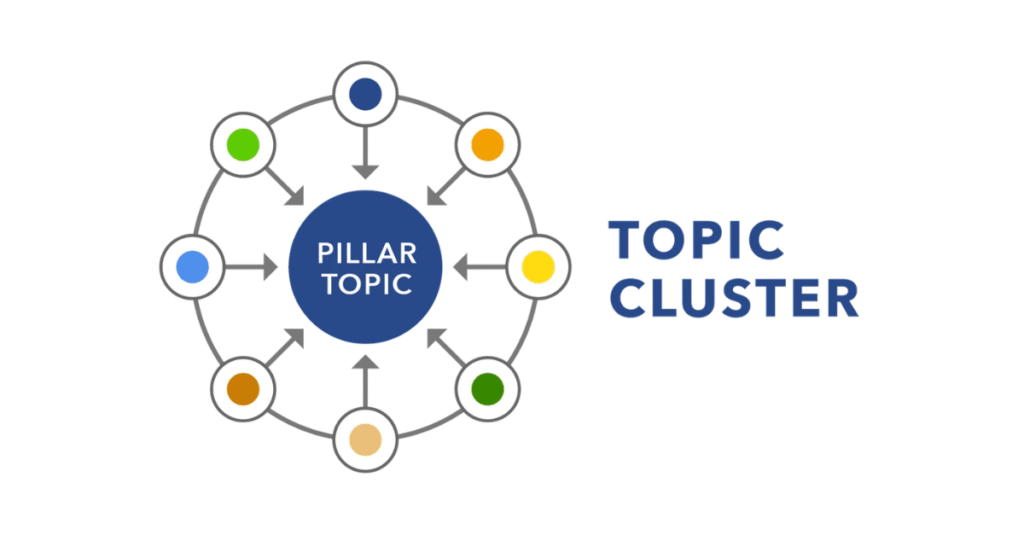
Topic clusters are a set of connected pages built around one main subject, with one pillar page and several supporting articles that cover the topic in depth. Done well, they help search engines understand what your site is known for and make it easier to build topical authority faster.
Here’s the thing: most sites do not lose because they publish too little. They lose because they publish random pieces that never connect.
If you want a site to rank for a competitive topic, you need more than one good article. You need a clear content structure that shows depth, focus, and real coverage.
What are topic clusters?
A topic cluster is a content system. One main page covers the broad subject, and the supporting pages handle the subtopics, questions, and use cases around it.
Think of a site about home espresso. The pillar page might be “Home Espresso Guide.” Around it, you could publish articles like:
- Best espresso grind size for beginners
- How to clean an espresso machine
- Espresso vs. ristretto
- How much pressure does an espresso machine need?
- Best budget espresso machines under $500
That is a cluster. One page gives the big picture. The others fill in the gaps.
This structure helps readers because they can move from one page to the next without searching all over the web. It also helps search engines because the relationship between pages is obvious.
Also Read: Easy Tips to Make Your Website Faster and Easier to Use.
Why topic clusters grow topical authority faster
Search engines do not just look at one page. They look for signs that a site understands a subject across multiple angles.
A single article about “best espresso machines” can rank. But a site with 12 related pages, clean internal links, and matching search intent usually has a stronger shot at building topical authority.
That happens for a simple reason: coverage.
If your site has one article on a subject, you look like an editor. If your site has a pillar page plus 8 to 15 useful supporting pages, you look like a source.
What most guides miss is this: topical authority is built page by page, but also link by link. The pages need to support each other. Without that, the site feels scattered.
How to choose a cluster topic that can actually rank
Not every topic deserves a cluster. Some are too broad. Some are too narrow. Some have no search demand at all.
Start with a subject that has enough room for at least 8 supporting pages. That is usually a good floor for a serious cluster.
For example:
- “Home coffee” can support dozens of articles.
- “How to descale a Breville Barista Express” is too narrow for a cluster by itself.
- “SEO” is broad enough, but it may be too competitive for a small site unless you narrow it to a sub-area like “SEO for dentists” or “local SEO audits.”
A quick test helps:
- Search the main topic in Google.
- Look at the People Also Ask questions.
- Check related searches at the bottom of the page.
- Scan the top 10 results.
- Ask whether you can write at least 8 genuinely different articles without forcing it.
If the answer is no, pick a different angle.
Also Read: Content Promotion Services to Increase Brand Visibility.
Picking a broad topic with real demand
A useful cluster topic has three things:
- clear search demand
- enough subtopics to cover
- room for commercial or lead-generating pages later
A B2B software site, for example, might choose “inventory management” instead of “inventory management for Shopify stores in Texas.” The first topic gives room to expand into guides, comparisons, templates, and how-to posts.
Checking if the site can support it
This part gets skipped a lot.
If your site is brand new, you do not need a 30-page cluster. A 6 to 10 page cluster is often better because it is easier to publish, link, and maintain.
A smaller site can win with focus. A local roofing company does not need 40 pages about roofing. It may need 1 pillar page, 6 service-supporting pages, and 5 local or problem-based articles.
That is enough to build momentum.
Also Read: Website Maintenance and Performance Improvement Plans.
How to build a topic cluster step by step
Now for the useful part.
Step 1: Define the pillar page
Your pillar page should cover the main subject from end to end, but it should not try to answer every small question in detail.
A pillar page for “content clusters” might include:
- what they are
- why they matter
- how they work
- how to plan one
- what mistakes to avoid
- links to supporting articles
Keep it broad, clean, and organized.
A solid pillar page often lands between 2,000 and 4,000 words, depending on the topic. A huge guide can work, but only if it stays readable. A wall of text is a bad trade.
Step 2: List supporting articles by search intent
This is where most teams make the wrong move. They brainstorm by topic first, not by intent.
Do it the other way around.
Group your supporting pages into intent buckets:
- Informational: what is topical authority, what is a content cluster, how internal links help SEO
- Comparisons: topic clusters vs. keyword silos, pillar pages vs. blog posts
- How-to: how to build a cluster, how to map internal links, how to audit pages
- Problem-solving: why a cluster is not ranking, why pages are cannibalizing each other
- Decision support: best tools for cluster planning, best ways to track results
A cluster with mixed intent often performs better than one with only “what is” content.
For example, a digital marketing site could build a cluster around “local SEO” with pages like:
- what local SEO is
- local SEO audit checklist
- how to optimize Google Business Profile
- local keyword research
- common local SEO mistakes
- local SEO reporting template
That mix helps the site answer beginner questions and practical questions.
Also Read: Paid Ad Management to Grow Targeted Website Leads Fast.
Step 3: Map internal links before writing
Do not wait until everything is published.
Plan the links first.
A simple model works well:
- The pillar page links out to every supporting article.
- Every supporting article links back to the pillar page.
- Supporting articles also link to 1 to 3 related pages in the cluster.
This creates a web of relevance instead of a pile of isolated posts.
Example: a post on “how to clean an espresso machine” might link to “best espresso machine maintenance schedule” and back to the “Home Espresso Guide” pillar page.
That link pattern helps readers move naturally and makes the cluster feel connected.
Step 4: Publish in a realistic order
Do not wait three months to launch everything at once.
Start with the pillar page and 3 to 5 high-value supporting posts. Then add the rest over the next 4 to 8 weeks.
That pace is easier for most teams. It also lets you learn from early results.
A good order is:
- pillar page
- highest-demand how-to article
- comparison page
- problem-solving page
- supporting glossary or FAQ page
This gives the cluster enough structure to start working without turning content production into a mess.
Also Read: Responsive Website Builds Focused on Speed and SEO.
Step 5: Refresh and expand the cluster
Clusters are not set-and-forget projects.
After 60 to 90 days, check which pages are getting impressions, clicks, and internal traffic. Then update the pages that need help.
A post might need:
- a better title
- a sharper introduction
- added examples
- more internal links
- a new section that answers a missing question
That small work can make a real difference. A page that sits at position 12 can sometimes move into the top 5 after a focused update.
What a strong topic cluster page structure looks like
A clean structure makes clusters easier to manage and easier to read.
Pillar page
Your pillar page should do four jobs:
- define the main topic
- summarize the major subtopics
- link to supporting pages
- guide the reader to the next step
A pillar page for “topic clusters” might have sections like:
- What topic clusters are
- Why they matter for topical authority
- How to build one
- Common mistakes
- A sample cluster map
Supporting article
A supporting article should go deep on one question.
Example:
- Pillar page: “Content Clusters Guide”
- Supporting page: “How to Write Supporting Articles for a Cluster”
The supporting page should not repeat the full pillar page. It should answer one part well, then send the reader back to the bigger guide.
Also Read: Local SEO Services to Boost Nearby Customer Traffic.
Link paths between pages
A strong cluster creates a clear path:
pillar page → supporting article → related supporting article → pillar page
That pattern keeps the cluster tight and easy to understand.
How many pages should a cluster have?
There is no magic number, but there are practical ranges.
When 8 pages is enough
A smaller cluster works well when:
- the site is new
- the topic is narrow
- the team has limited writing capacity
- the audience has only a few major questions
A local service site, for example, might get strong results from 1 pillar page and 7 supporting pages.
When 20 pages makes more sense
A larger cluster makes sense when:
- the topic has many sub-questions
- the site already has some authority
- the goal is to dominate a subject category
- the business can publish steadily
An ecommerce blog about running shoes could easily support 20 pages across shoe types, fit, injury prevention, care, and comparison content.
The key is not size for its own sake. It is coverage that feels complete.
Also Read: Technical SEO Fixes for Faster Site Indexing and Crawling.
Common mistakes that weaken topic clusters
A lot of clusters fail for the same reasons.
Writing near-duplicate articles
This is the fastest way to waste time.
If you publish three pages that all answer almost the same question, you create overlap and confusion. Search engines do not need three versions of the same thing.
Example: “What is topical authority?”, “Topical authority explained,” and “How topical authority works” may be too close together unless each page has a very different angle.
Linking without a plan
Random internal links do not help much.
If every post links to every other post, the site turns messy. A focused link map works better than a crowded one.
Choosing topics too wide or too small
If the topic is too wide, the cluster becomes impossible to finish. If it is too small, the cluster has no room to grow.
A topic like “marketing” is too broad for most sites. A topic like “how to replace a Google Ads conversion tag” is too narrow.
Aim for the middle.
Ignoring search intent
This one hurts rankings and conversions.
A page that tries to rank for “how to build topic clusters” but gives only a general SEO lecture will miss the mark. The page needs practical steps, examples, and a structure that matches the query.
How to measure whether topic clusters are working
Do not guess. Check the numbers.
Here are the main signals to watch:
- Impressions: Are more pages showing in Google Search Console?
- Clicks: Are people choosing your pages over time?
- Average position: Are more pages moving from page 2 to page 1?
- Internal clicks: Are readers moving from pillar pages to supporting pages?
- Organic sessions: Is total search traffic rising?
- Leads or sales: Is the cluster helping the business, not just traffic?
A simple example: if a 10-page cluster gets 4 pages onto page 1 and 3 more pages onto page 2 within 3 months, that is a strong sign the structure is working.
Use Google Search Console, GA4, and your rank tracker together. One tool by itself will not tell the whole story.
A simple topic cluster example
Let’s use a home coffee site.
The pillar page is: Home Espresso Guide
Supporting pages:
- How to grind coffee for espresso
- Best water temperature for espresso
- How to clean an espresso machine
- Espresso machine pressure explained
- Best budget espresso machines under $500
- Espresso vs. lungo
- How to tamp coffee correctly
- Beginner espresso mistakes to avoid
This cluster covers education, buying, troubleshooting, and technique. A reader can start with one page and keep going without leaving the site.
That is the point.
A cluster like this also gives the site a better shot at building topical authority because it shows depth from several angles, not just one post written for one keyword.
Why most teams get topic clusters wrong
They treat clusters like a publishing checklist.
Publish a pillar page. Add a few articles. Done.
That is too shallow.
The better approach is to treat the cluster as a subject map. Every page should have a job. Every link should have a reason. Every update should make the whole group stronger.
That sounds simple because it is. The hard part is discipline.
A site that publishes 12 focused pages around one topic usually beats a site that publishes 50 unrelated posts. Every time.
FAQ: Topic clusters and topical authority
What is a topic cluster in SEO?
A topic cluster is a group of related pages built around one main subject. It usually includes a pillar page and several supporting articles that connect through internal links. This helps organize content and strengthen topical authority.
How many pages should a topic cluster have?
A practical starting point is 6 to 10 pages. Smaller topics may need fewer, while broader subjects can support 15 or more. The right number depends on search demand and how much useful ground you can cover without overlap.
Do topic clusters still help with SEO?
Yes, because they make your site easier to understand and easier to crawl. They also improve internal linking, which can help distribute relevance across related pages. The real benefit is clearer subject coverage, not a trick or shortcut.
What is the difference between a pillar page and a cluster page?
A pillar page covers the main topic at a broad level. A cluster page focuses on one subtopic in depth. The pillar page points readers to the supporting pages, and the supporting pages link back to the pillar.
How long does it take to see results from topic clusters?
Some pages can start getting impressions in a few weeks, but stronger results usually take 2 to 4 months. New sites may need longer. The speed depends on site history, competition, and how well the pages match search intent.
Conclusion
Build the cluster around one clear subject, link every page with purpose, and keep the content focused on one real audience need. That is the fastest path to stronger SEO authority.
For more useful articles, visit my website: HighSoftware99.